The article I
chose to read and write about was not easy to find. I searched through the “rethinking schools” database a handful of times before I came across
an article I felt that resonated with me, and one I would want to share on my
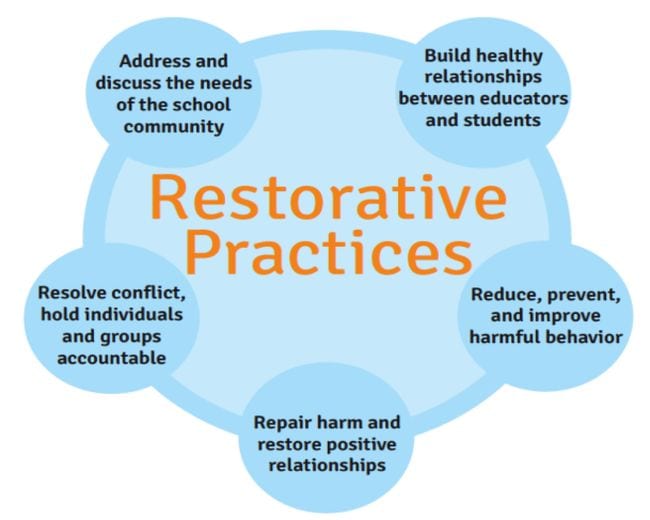
blog. The topic I chose reflected a topic new to myself this school year. Restorative justice. I learned
about this practice by reading a book called, “Better Than Sticks Or Carrots” by d. Smith, D. Fisher, and N. Frey.
The book focuses on restorative
practices for positive classroom management and includes explanations, ideas,
strategies, and references. The article read
is also about restorative practices and reflect what I have learned when reading
the book. For more information on this,
go here, ( Restorative Justice: Resources for Schools). The site offers
information about case studies and ways to bring
the practice to your school, along with additional resources. The next site offers a real life example,
along with drawbacks to restorative justice. ( What Teachers Need to Know About Restorative Justice)
This
author Linea King argues in Volume 29, No 4, Summer 2015, that in order to create a strong community classroom
the environment must be welcoming, positive, all while being productive. In the article, there
was a particular incident that drove this teacher to look at her methods of
handling classroom disruptions in a different light. She noticed she was the one who continued to
break up their classroom community by sending disruptive students out of the
room. She states, “When one person is
gone, it breaks the circle and makes each of us incomplete.” This quote refers
to her individual class as a smaller community within their school and as small as it may appear compared to the big picture, it is equally, if not more
important. As a homeroom/ advisory
teacher, I agree with this wholeheartedly.
From day one in my homeroom, I share with the students that I always
have the best homeroom and that they are the best homeroom this school year.
Another
quote that resonated with me is, “This kid is making it impossible for me to
teach, and so he is the sacrificial lamb for the greater good.” I have personally been in a position where I
have asked a student to leave because his/her behavior was such a disruption
that the lesson could simply not continue.
Easy fix? Send the student out,
let the office deal with his/ her behavior and carry on. The problem with this is that that same
student will return to class at some point.
Maybe the same level, or maybe the next day, but be certain, the student
will return.
The
last piece that reflects our current readings in our class is “Facing the
Harm.” Understand that I am generalizing
this phrase and placing it under an umbrella of facing ALL that we encounter in
our classrooms. (The good, the not so
good, the differences, the sameness, the colorblindness, the perpetual behavior
of students and teachers, because we are not FACING (insert what you are not
facing). One reading this article reminded me of is, “Introduction: Creating Classrooms for Equity and Social Justice.” The article states, “If we ask children
to critique the world but then fail to encourage them to act, our classrooms
can degenerate into factories of cynicism.”
 Creating
a community is an on-going process that requires work. The work is sometimes harder than other
times, but non-the- less, work. And so the teacher being referenced in the
story began creating her classroom community by discussing the problem, (Taken straight from a piece of the
article, “Adolfo and Abdi were in my class of
Latina/o and Somali intermediate and early advanced English language learners
(ELLs). Many of my students were also in Spanish dual immersion and/or special
education classes, so they had no nonacademic electives; in other words, no
gym, no art, no music, no alternative ways to express themselves. This was the
last class of the day, and many of us were tired and often frustrated.)
Creating
a community is an on-going process that requires work. The work is sometimes harder than other
times, but non-the- less, work. And so the teacher being referenced in the
story began creating her classroom community by discussing the problem, (Taken straight from a piece of the
article, “Adolfo and Abdi were in my class of
Latina/o and Somali intermediate and early advanced English language learners
(ELLs). Many of my students were also in Spanish dual immersion and/or special
education classes, so they had no nonacademic electives; in other words, no
gym, no art, no music, no alternative ways to express themselves. This was the
last class of the day, and many of us were tired and often frustrated.)
Adolfo and Abdi got in a fistfight
with one another and this is when she realized something more had to be done
besides sending students out of the room, writing up referrals, which sometimes
resulted in suspensions.
Another
reading this connects to is, ““The
Silenced Dialogue: Power and Pedagogy in Educating Other People’s Children;” By
l. Delpit. The reason I chose this
connection is because the two students referenced in the article are ELL
learners who are Latino or Somali. Delpit
summarizes that, “students must be taught the codes needed to participate fully
in mainstream American life,…..within the context of meaningful communicative
endeavors…” Here the teacher would
model, explain and continue to model appropriate ways to communicate effectively,
perhaps in a different manner they were taught in their homeland.
After reading the book, “Better Than Sticks Or Carrots” by d. Smith, D. Fisher, and N. Frey. I implemented restorative justice activities in my advisory. One activity began by gathering my students in a circle and having them share either one positive thought or one not so positive thought on their minds. The students were directed to not interrupt, and asked to not ask questions. This activity’s purpose was to let students share what was on their minds without worrying about comments from others. This community engaging activity brought us together and enabled us to get to know one another on a different level. I also created a Help Wanted / Expert Available Google Doc that I placed on our Homeroom Google Classroom. Here the students were asked to list their names and what content areas they are an “expert” in. Once the students added their names, other students were able to seek out the “expert” for help. This particular activity was a great way to see students work with one another in order to help other be more successful.
I look forward to poking around “rethinking schools” when time permits. I feel confident I will find many readings that will resonate with me.
I look forward to poking around “rethinking schools” when time permits. I feel confident I will find many readings that will resonate with me.

I loved reading your post Jamie, because I too just learned about Restorative Justice at my school this year, and I LOVE IT!!! Currently, I'm working with my school next year to try to get official training in it. We had a small group of teachers who did the introduction of RJ with the faculty, and part of the learning actually included that 1 positive/1 negative fact activity (something to try during Morning Meeting to build community).. I work in urban Providence, so the "school to prison pipeline" is so real for me, and that is why I'm such a strong advocate for RJ, and hope more schools in RI adopt it in their practice..great post!!! I love your cartoon about suspension too! So true!
ReplyDeleteJamie, this sounds like a good read. I like how the author views the community within the classroom as incomplete when some of the "behaviors" are sent out of the room. You are right, these students may have not been taught the codes of behavior within a classroom. I really like the activities you have been incorporating into your advisory class. By having the students offer their thoughts without interruption accomplishes many things. First the students get the opportunity to relate to one another and realize that someone else may have the same thoughts (positive or negative) as they do as well as working on their listening skills. Being able to really listen to someone is a skill that is not easily learned and I think this activity is a great way to hone that skill. I also really like the other help wanted/expert available activity. What a great way to teach kids not only to help each other but also to ask for help.
ReplyDeleteJamie,
ReplyDeleteI'm interested in hearing from you about the restorative practices and how they work within the rest of your school. Not to be a debby-downer, but I have worked in a school in Central Falls where they used the restorative practices model and I saw it have very negative effects, quite the opposite of yours. Now, let me preface this with the fact that they could have been implemented poorly, or the people in charge might not have been properly trained in the matter. SO, I'm wondering... what is your school doing to make them work so positively?
Thanks,
Taylor
Hi Jamie,
ReplyDeleteI really enjoyed reading about the article you selected. Restorative Justice is definitely a ‘hot topic’ now in the field of education and one that the Providence School District is trying to utilize. While I think these practices are essential and necessary for teachers to be aware of, I often wonder what happens in classrooms that are not aware of these practices. Through some of my course work, I have had to read about a few of the practices that are illustrated in the book. One of the most important parts of your post is the importance of creating a community in the classroom that is welcoming and comfortable for students. I have seen the way students interact with teachers that create these environments and teachers that don’t and the interactions are COMPLETELY different. Thanks for sharing!
Jamie, when reading about the two students that were emergent bilinguals that got into a fist fight, I think what you connected to about teaching the codes of power was true. But I also think that in this situation the students are probably going through a lot emotionally, possibly feeling "different" because they don't speak English as well and are therefore not understood as easily; not getting any elective classes to participate in; maybe their families are new to the US and are going through adjustments at home as well. For me, reading about that situation, I think it was great that the teacher realized the whole situation for these students and decided they were lacking something (support) that they needed and realized that just sending students out of the room would not "fix the problem." I think many times sending students out of the room is an immediate and quick fix, but like you mentioned, it doesn't get to the root of the problem, and when those students return to class at some point, the problem of their behavior challenges will mostly likely still remain. it is important for us as teachers to help advocate for more support for students and make changes in our classrooms to provide more social-emotional support and teachings for all of our students. It is just as important as the academics, if not more important.
ReplyDeleteJamie, great post. This really made me reflect on the way I view discipline in the classroom. I have definitely had the moment where i have thought: "this class would be so much better if XXX wasn't in it." This is a sentiment I feel most teachers have experienced. But as you point out, even if you dismiss your student, they will be back, and then what do you do? Restorative justice practices allow students and teachers to both have a hand in the behavioral management of the classroom, and therefore allow the teachers and students to build bonds, rather than rifts. I would like to start implementing this in my own classroom! Thanks!
ReplyDeleteSounds like you got so much out of this article! The issue of "discipline" is such a key social justice issue. And I know you will find other important text in the RS journal!
ReplyDelete