The article I
chose to read and write about was not easy to find. I searched through the “rethinking schools” database a handful of times before I came across
an article I felt that resonated with me, and one I would want to share on my
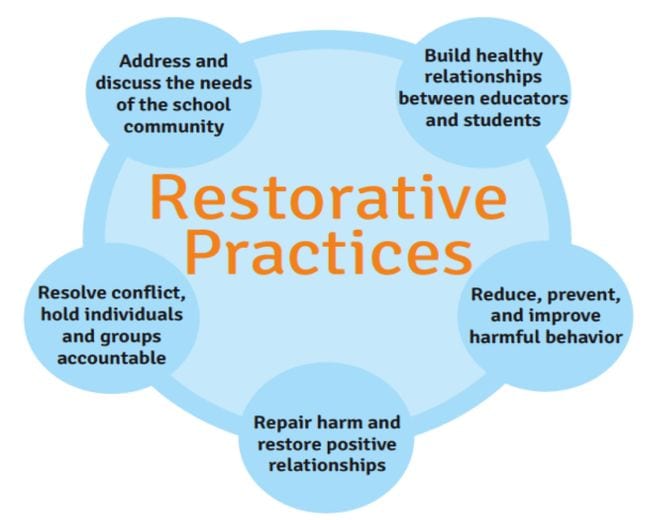
blog. The topic I chose reflected a topic new to myself this school year. Restorative justice. I learned
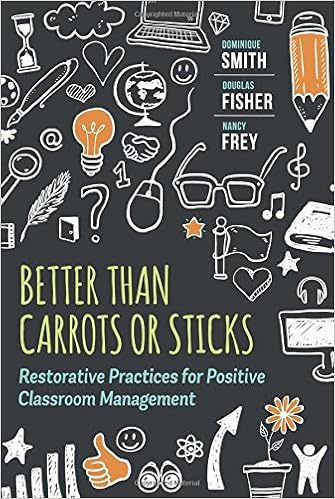
about this practice by reading a book called, “Better Than Sticks Or Carrots” by d. Smith, D. Fisher, and N. Frey.
The book focuses on restorative
practices for positive classroom management and includes explanations, ideas,
strategies, and references. The article read
is also about restorative practices and reflect what I have learned when reading
the book. For more information on this,
go here, ( Restorative Justice: Resources for Schools). The site offers
information about case studies and ways to bring
the practice to your school, along with additional resources. The next site offers a real life example,
along with drawbacks to restorative justice. ( What Teachers Need to Know About Restorative Justice)
This
author Linea King argues in Volume 29, No 4, Summer 2015, that in order to create a strong community classroom
the environment must be welcoming, positive, all while being productive. In the article, there
was a particular incident that drove this teacher to look at her methods of
handling classroom disruptions in a different light. She noticed she was the one who continued to
break up their classroom community by sending disruptive students out of the
room. She states, “When one person is
gone, it breaks the circle and makes each of us incomplete.” This quote refers
to her individual class as a smaller community within their school and as small as it may appear compared to the big picture, it is equally, if not more
important. As a homeroom/ advisory
teacher, I agree with this wholeheartedly.
From day one in my homeroom, I share with the students that I always
have the best homeroom and that they are the best homeroom this school year.
Another
quote that resonated with me is, “This kid is making it impossible for me to
teach, and so he is the sacrificial lamb for the greater good.” I have personally been in a position where I
have asked a student to leave because his/her behavior was such a disruption
that the lesson could simply not continue.
Easy fix? Send the student out,
let the office deal with his/ her behavior and carry on. The problem with this is that that same
student will return to class at some point.
Maybe the same level, or maybe the next day, but be certain, the student
will return.
The
last piece that reflects our current readings in our class is “Facing the
Harm.” Understand that I am generalizing
this phrase and placing it under an umbrella of facing ALL that we encounter in
our classrooms. (The good, the not so
good, the differences, the sameness, the colorblindness, the perpetual behavior
of students and teachers, because we are not FACING (insert what you are not
facing). One reading this article reminded me of is, “Introduction: Creating Classrooms for Equity and Social Justice.” The article states, “If we ask children
to critique the world but then fail to encourage them to act, our classrooms
can degenerate into factories of cynicism.”
 Creating
a community is an on-going process that requires work. The work is sometimes harder than other
times, but non-the- less, work. And so the teacher being referenced in the
story began creating her classroom community by discussing the problem, (Taken straight from a piece of the
article, “Adolfo and Abdi were in my class of
Latina/o and Somali intermediate and early advanced English language learners
(ELLs). Many of my students were also in Spanish dual immersion and/or special
education classes, so they had no nonacademic electives; in other words, no
gym, no art, no music, no alternative ways to express themselves. This was the
last class of the day, and many of us were tired and often frustrated.)
Adolfo and Abdi got in a fistfight
with one another and this is when she realized something more had to be done
besides sending students out of the room, writing up referrals, which sometimes
resulted in suspensions.
Another
reading this connects to is, ““The
Silenced Dialogue: Power and Pedagogy in Educating Other People’s Children;” By
l. Delpit. The reason I chose this
connection is because the two students referenced in the article are ELL
learners who are Latino or Somali. Delpit
summarizes that, “students must be taught the codes needed to participate fully
in mainstream American life,…..within the context of meaningful communicative
endeavors…” Here the teacher would
model, explain and continue to model appropriate ways to communicate effectively,
perhaps in a different manner they were taught in their homeland.
After reading the book, “Better Than Sticks Or Carrots” by d. Smith, D. Fisher, and N. Frey. I implemented restorative justice activities in my advisory. One activity began by gathering my students in a circle and having them share either one positive thought or one not so positive thought on their minds. The students were directed to not interrupt, and asked to not ask questions. This activity’s purpose was to let students share what was on their minds without worrying about comments from others. This community engaging activity brought us together and enabled us to get to know one another on a different level. I also created a Help Wanted / Expert Available Google Doc that I placed on our Homeroom Google Classroom. Here the students were asked to list their names and what content areas they are an “expert” in. Once the students added their names, other students were able to seek out the “expert” for help. This particular activity was a great way to see students work with one another in order to help other be more successful.
I look forward to poking around “rethinking schools” when time permits. I feel confident I will find many readings that will resonate with me.

