Sunday, June 9, 2019

2 article summaries for Final Project

               "Safe Spaces" - Vaccaro, August, Kennedy


“Safe Spaces,” discusses how classrooms consist of students and teachers who bring their funds of knowledge with them each and every day and then leave with hopefully, more knowledge and understanding than what they arrived with.  Though there are many factors that each individual carries in their metaphorical backpacks, they may not be compartmentalized.  Instead, the lessons taught by many different people blend into one another as the individual attempts to file and make sense of them by linking them to one another.  With these new lessons come a responsibility of the teachers and the school to help students feel accepted and appreciated, and offer guidance with new ways of thinking in how one should behave when the status quo is no longer the status quo.
As the author suggests, “If our homes are incubators, keeping our children safe as they grow into the patterns of family life, schools are "outcubators" - places that introduce new ways of thinking and behaving. Social and psychological development progress as young people move through our educational system....." (p.84).


“Privilege, Power, and Difference” - A. Johnson

“Privilege, Power, and Difference” discusses the importance of becoming aware of being a part of the “luxury class.’  In order for society to change, we must look within ourselves, see how we are contributing to the current situation, (of treating people differently) and most importantly be honest with ourselves.  For one to be mindful of personal social status, there may be a better chance that there is a deeper understanding, belief, and acceptance of others who are not.  Changing our thinking, our actions, and how we take action is how to create change in our local communities.  As the wheel of diversity defines what is privileged, characteristics of one-self are what shape our lives.  Regardless of what we are on the inside, what we show to be on the exterior is what categorizes us in society; therefore how we are viewed and treated.  Although we did not create the diversity in this world, we may be a part of it now.

Going To School by Richard Cohen


           Going To School by Richard Cohen is a short film that touches on the issues of a particular district in Los Angeles and that argues that the locals in charge have been taking advantage of parents and guardians of students with disabilities.  The film revealed that there were many instances that students who required more assistance with their learning or mobility where placed in a holding pattern for many years where they were secluded from their local communities and local peers.  Instead these individuals were bused many miles away from their local school that their peers attended and were not afforded the opportunities to be exposed to the general education setting.  Although IDEA was passed in 1975, there were approximately 1 million students who were separated and prevented from going to school with those who did not have a disability.  This link to IDEA takes you to the government site that has several resources to help those with questions and concerns. (Government - IDEA)
Image result for photo of education 
         The numerous links within this site are easily to navigate through and offer a plethora of information from definitions, laws and policies, current data reports, grants and funding available, and news and media information.  The news and media link connects to Facebook, Twitter, and blogs. There is also an opportunity to subscribe to their handful of newsletters as well as access to the archived reports.  The site is transparent in their intent and purpose.
Image result for photo of special education           These basic human rights that were stripped from students and their parents received push back by several parents who believed their child should attend school of their residence; therefore demanding inclusion for all.  They has their voices heard that this was a civilized way to instruct ALL people. As Martinez stated, “I am fighting for a general education setting for my son.”  Martinez now leads PRN, Parent Resource Network, where other parents can turn to for assistance with understanding theirs and their child’s rights concerning free appropriate education. The following link (Family Resources) brings you to a site that has 13 Family Resources Centers in Los Angeles county. Their mission statement states that their purpose is to, “promote, expand and share available resources with families that have children with special health care needs and / or other disabilities in Los Angeles County.”  The help from the network is to “liberate parents to help them advocate for their child regardless of the disability or the language spoken.”  Having a voice to express concerns or approval should be a practice all people in our society has the option to do.  Unfortunately, those with little knowledge of the system, the country, or the language would create a roadblock in order to make this simple act not so simple.
            This video takes me back to the article, “Teaching at the Intersection.”  The following quote from the article states, “navigate the world, and the way the world respond to them,” (pg. 6) is critical for all people in society to feel safe and accepted. The parents’ of students who were moved to their school of residence stated that now when they are out shopping in their local stores peers come to them and greet their child, whereas previously, children would walk by and not even know who their child was. 
Let's spread like a meme.
                                                                 Image result for memes students and IDEA
Another article I connect this video to is the “The Silenced Dialogue.”  It states, “There are codes or rules for participating in power; that is, there is a “culture of power,” (pg. 25).  This particular quote also reminds me of the following TED Talk I was introduced to.  It focuses on how people speak differently, but non- the-less, communicate their ideas.  Click here for the full video that Jamila Lyiscott describes 3 Ways to speak English. (TED Talk - 3 Ways to speak English)    
Although this video discusses the different dialects, it shares the underground notion that they way one communicates is judged.   I believe if the students such as Martinez, Nalley, and Nhien were mainstreamed the same time as their peers,  there would not have been any “getting used to” them in the first place.  As Nalley’s parents shared, children were warehoused in segregation.
            The video captures a whole community as it navigates the topic of children with disabilities while getting the attention of policy makers and the public. The discussion of inclusion, integration and discrimination is at the forefront. Awareness is knowledge and knowledge is POWER. The following link offers steps to create a safe productive environment for all students.  (Crisis Prevention)    
Image result for photo of education

Wednesday, June 5, 2019

6/5 FINAL PROJECT PROPOSAL DRAFT

 6/5 FINAL PROJECT PROPOSAL DRAFT 

→Choose a topic
              - students reflect on situations when they have been a silent bystander

→Choose 2 articles to summarize
   ~ "Safe Spaces" - Vaccaro, August, Kennedy
   ~ “Privilege, Power, and Difference" -  A. Johnson

           
    → Explain what and to whom you will teach... and how

                 ~ homeroom advisory class will be prompted to discuss four roles (victim, bystander, rescuer, and perpetrator), and then led into the beginning of our activity, which will include discussing difficult topics, what makes a person act one way (bystander) or another (ally) in said situation, and generating ideas to become an ally.

Safe Spaces

"Safe Spaces" - Vaccaro, August, Kennedy
www.GLSEN.org


Three Talking Points

~ "We content that the winners are those who see themselves in textbooks, art, film, and other educational materials. Youth who see themselves as wise or powerful main characters or heroes worthy of celebration and emulation will feel validated, included, and safe inside their classrooms." (p.85)

~ "California recently passed the Fair Accurate, Inclusive, and Respectful (FAIR) Education Act, which requires public school social science curricula to include the contributions to LGBT individuals." (p.87)

~ "From Statehouse to Schoolhouse" #KindnessInAction (www.GLSEN.org)

Argument Statement
This author August, argues that, "If our homes are incubators, keeping our children safe as they grow into the patterns of family life, schools are "outcubators" - places that introduce new ways of thinking and behaving. Social and psychological development progress as young people move through our educational system....." (p.84)


Sunday, June 2, 2019

RethinkingSchools in the Context of Power


Image result for restorative justice in schools
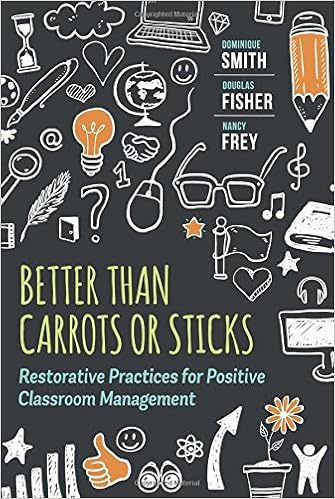
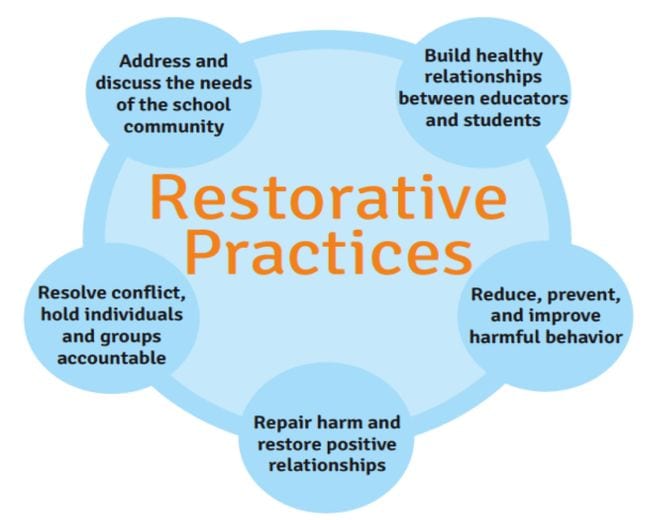
The article I chose to read and write about was not easy to find.  I searched through the “rethinking schools” database a handful of times before I came across an article I felt that resonated with me, and one I would want to share on my blog.  The topic I chose reflected a topic new to myself this school year. Restorative justice. I learned about this practice by reading a book called, “Better Than Sticks Or Carrots” by d. Smith, D. Fisher, and N. Frey.  The book focuses on restorative practices for positive classroom management and includes explanations, ideas, strategies, and references.  The article read is also about restorative practices and reflect what I have learned when reading the book.  For more information on this, go here, ( Restorative Justice: Resources for Schools).  The site offers information about case studies and ways to bring the practice to your school, along with additional resources.  The next site offers a real life example, along with drawbacks to restorative justice. (What Teachers Need to Know About Restorative Justice)  
Image result for better than carrots or sticks

             This author Linea King argues in Volume 29, No 4, Summer 2015, that in order to create a strong community classroom the environment must be welcoming, positive, all while being productive. In the article, there was a particular incident that drove this teacher to look at her methods of handling classroom disruptions in a different light.  She noticed she was the one who continued to break up their classroom community by sending disruptive students out of the room.  She states, “When one person is gone, it breaks the circle and makes each of us incomplete.” This quote refers to her individual class as a smaller community within their school and as small as it may appear compared to the big picture, it is equally, if not more important.  As a homeroom/ advisory teacher, I agree with this wholeheartedly.  From day one in my homeroom, I share with the students that I always have the best homeroom and that they are the best homeroom this school year.
            Another quote that resonated with me is, “This kid is making it impossible for me to teach, and so he is the sacrificial lamb for the greater good.”  I have personally been in a position where I have asked a student to leave because his/her behavior was such a disruption that the lesson could simply not continue.  Easy fix?  Send the student out, let the office deal with his/ her behavior and carry on.  The problem with this is that that same student will return to class at some point.  Maybe the same level, or maybe the next day, but be certain, the student will return.
            The last piece that reflects our current readings in our class is “Facing the Harm.”  Understand that I am generalizing this phrase and placing it under an umbrella of facing ALL that we encounter in our classrooms.  (The good, the not so good, the differences, the sameness, the colorblindness, the perpetual behavior of students and teachers, because we are not FACING (insert what you are not facing). One reading this article reminded me of is, “Introduction: Creating Classrooms for Equity and Social Justice.”  The article states, “If we ask children to critique the world but then fail to encourage them to act, our classrooms can degenerate into factories of cynicism.” 
Image result for better than carrots or sticks            Creating a community is an on-going process that requires work.  The work is sometimes harder than other times, but non-the- less, work.  And so the teacher being referenced in the story began creating her classroom community by discussing the problem, (Taken straight from a piece of the article, “Adolfo and Abdi were in my class of Latina/o and Somali intermediate and early advanced English language learners (ELLs). Many of my students were also in Spanish dual immersion and/or special education classes, so they had no nonacademic electives; in other words, no gym, no art, no music, no alternative ways to express themselves. This was the last class of the day, and many of us were tired and often frustrated.)
Adolfo and Abdi got in a fistfight with one another and this is when she realized something more had to be done besides sending students out of the room, writing up referrals, which sometimes resulted in suspensions.  

            Another reading this connects to is, ““The Silenced Dialogue: Power and Pedagogy in Educating Other People’s Children;” By l. Delpit.  The reason I chose this connection is because the two students referenced in the article are ELL learners who are Latino or Somali.  Delpit summarizes that, “students must be taught the codes needed to participate fully in mainstream American life,…..within the context of meaningful communicative endeavors…”  Here the teacher would model, explain and continue to model appropriate ways to communicate effectively, perhaps in a different manner they were taught in their homeland.   
        
            After reading the book, “Better Than Sticks Or Carrots” by d. Smith, D. Fisher, and N. Frey. I implemented restorative justice activities in my advisory.  One activity began by gathering my students in a circle and having them share either one positive thought or one not so positive thought on their minds.  The students were directed to not interrupt, and asked to not ask questions.  This activity’s purpose was to let students share what was on their minds without worrying about comments from others.   This community engaging activity brought us together and enabled us to get to know one another on a different level.  I also created a Help Wanted / Expert Available Google Doc that I placed on our Homeroom Google Classroom. Here the students were asked to list their names and what content areas they are an “expert” in.  Once the students added their names, other students were able to seek out the “expert” for help.  This particular activity was a great way to see students work with one another in order to help other be more successful. 
        I look forward to poking around “rethinking schools” when time permits. I feel confident I will find many readings that will resonate with me.